

Keywords
value
justice
responsibility
equality
public consciousness
Adal Azamat
How to Cite
Abstract
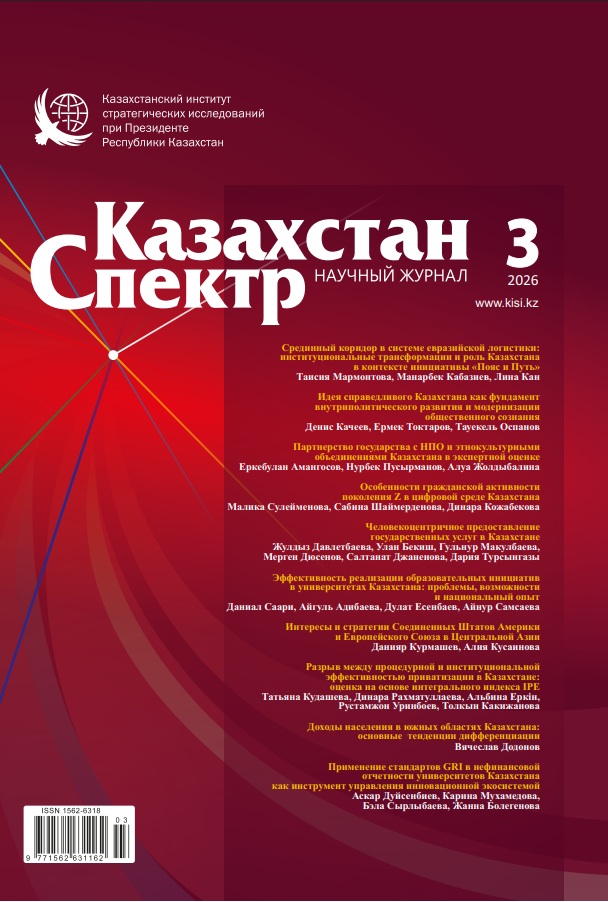
The article examines the idea of a Just Kazakhstan as the foundation for the political reform of the republic initiated by President K. Tokayev. It considers the conditions that shaped the transition to the idea of a Just Kazakhstan following the January events and the Constitutional Reform of 2022. The article demonstrates that this idea cannot be reduced to a political slogan or an administrative programme, since it functions as a model for legitimising reforms, within which justice is understood simultaneously as legal equality, institutional accountability, social responsibility, and civic participation.
It is noted that justice forms part of the foundations of Kazakhstan’s public consciousness and is perceived by citizens not merely as an abstract norm, but as a lived social practice. At the same time, the article concludes that the influence of the idea of a Just Kazakhstan on public consciousness is not a completed process. Rather, it depends on the stability of law enforcement practices, the quality of institutions, trust in the state, and the capacity of civil society to translate the values of justice and responsibility into everyday social practices.

This work is licensed under a Creative Commons Attribution 4.0 International License.
Copyright (c) 2026 Kazakhstan-Spectrum