

Keywords
How to Cite
Abstract
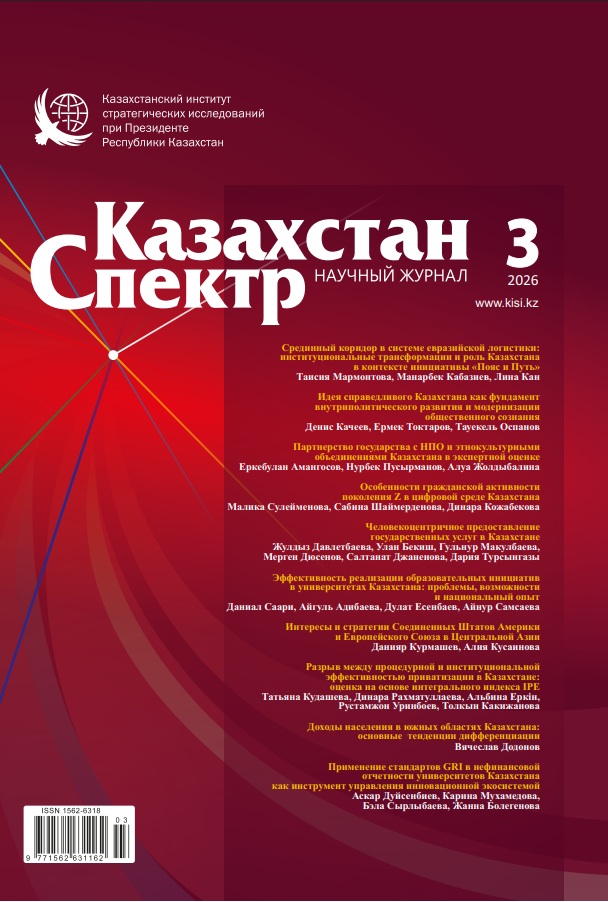
The article «The Effectiveness of Implementing Educational Initiatives in Kazakhstan's Universities: Challenges, Opportunities, and National Experience» examines the effectiveness of educational initiatives in Kazakhstan's universities through a comparative analysis of three case studies: Al-Farabi Kazakh National University, Nazarbayev University, and South Kazakhstan State Pedagogical University. The study utilizes a multiple-case study design and secondary data for 2020-2024. Effectiveness is assessed using four sets of criteria: resource provision, scale of implementation, immediate results, and proven impacts. The comparison revealed that the sources most comprehensively document the initiatives' focus and organizational outcomes in digitalization, international cooperation, research, and engagement with employers. However, comparable quantitative data on educational impacts, funding, industrial partnerships, and the impact of autonomy are presented fragmentarily. The scientific novelty of the study lies in distinguishing between the implementation of an initiative and its proven impact using a unified analytical framework. A monitoring format is proposed that includes the baseline, period, resources, coverage, immediate outcome, and target indicator dynamics. Conclusions are limited by the qualitative nature and variable availability of data across cases.

This work is licensed under a Creative Commons Attribution 4.0 International License.
Copyright (c) 2026 Kazakhstan-Spectrum