

Keywords
How to Cite
Abstract
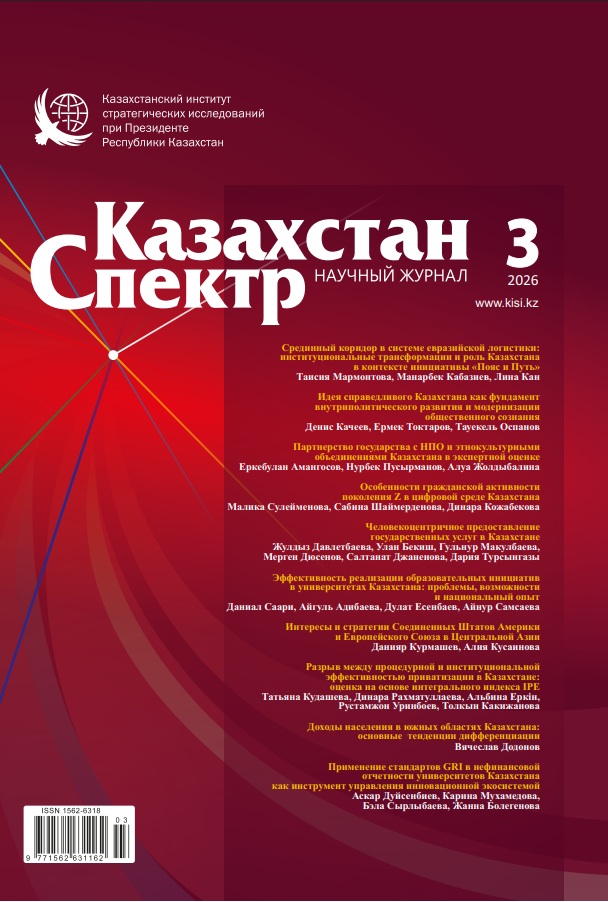
This article examines the civic activity of the young generation of Kazakhstan aged 14 to 28, also known as Generation Z, with a focus on the characteristics of their involvement in social and political processes. Young people of this age group are characterized as a digital generation, as they grew up in the context of intensive digitalization and the widespread use of modern technologies. Particular attention is paid to the analysis of youth activity, which demonstrates a clear imbalance between informal and formal forms of participation.
Informal participation is mainly expressed through volunteering, social initiatives, and online discussions, where young people actively demonstrate their civic position. At the same time, involvement in formal civic structures, such as political parties and youth councils, remains low. One of the main reasons for this is the lack of trust in institutional mechanisms, as well as the limited attractiveness of official channels for active participation.
The article emphasizes that the primary civic energy of young people is directed toward social and digital forms of engagement, where they feel more free, secure, and capable of influencing ongoing processes. As a result, a shift from traditional forms of civic participation toward more flexible and non-formalized modes of expression and involvement is observed.
In addition, the study analyzes key barriers that hinder young people’s transition to more formalized forms of civic engagement and proposes possible ways to overcome this imbalance. The research makes a significant contribution to understanding the behavior of the new generation, which is expected to have a considerable impact on the country’s electoral system in the future.

This work is licensed under a Creative Commons Attribution 4.0 International License.
Copyright (c) 2026 Kazakhstan-Spectrum